

Pulp
Basking in the afterglow of a perfect concert.

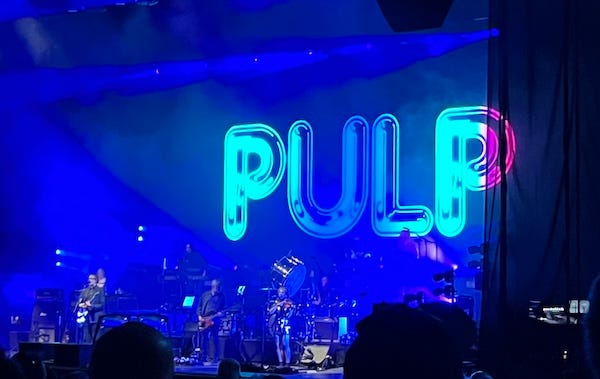
This week, I finally got to see Pulp in concert. Last year, a scheduling snafu kept me from their more intimate shows at History, and if I’d seen them at the Opera House back in 1996, I probably would have burst into flames.
Dozens of friends were at the show too, according to the flood of social media posts I saw, but I chose to go alone. I needed some privacy to commune with my feelings.
I had many favourite bands when I was in high school (a time of life when music felt as essential as breathing), but none provided a more perfect soundtrack for my teenage angst than Pulp.
Of course I listened to grunge (in part because the cutest boys with the most enviably long and glossy hair did), and indie rock (Pavement spoke to my soul, I swear it), and hip hop (Wu Tang transcended teen-subcultural barriers, at least in my neck of the suburban woods), but having been raised by a woman who was a major Anglophile, British bands held an allure and mystique that others didn’t.
If Oasis and Blur were the Coke and Pepsi of Britpop, then Pulp was Dr. Pepper.
Objectively more delicious, and infinitely cooler for being a bit more niche (remember when “selling out” for mainstream success was the worst thing an artist could do? Which is not to say that Pulp didn’t achieve mainstream success, but they were certainly dwarfed by the behemoth of Oasis).
I was in grade 11 when His & Hers came out, and just starting my grade 13 year (back when Ontarians did five years of high school) when Different Class came out, so those albums perfectly bookended the most tumultuous and challenging period of my adolescence. I was moody and brooding, and my hormones were way, waaaaaaay out of control. If I had a type in my teens, then Jarvis Cocker, with his breathy voice, his gangly, occasionally-bespectacled, art-nerd looks and impeccably sharp suits, was IT. The frontmen of my other favourite bands just looked like regular dudes. Which is to say, they were gum under his shoe.
I also liked Pulp because there was a woman in the band. That meant something to me at the time, and still does.
On Tuesday, when the band came on stage and kicked off their set with “Sorted for E’s and Wizz” followed by “Disco 2000,” I burst into tears.
I was so glad to see Candida Doyle looking like a cool art teacher in a swishy white dress, and two other original members (Nick Banks and Mark Webber) looking like nice dads from the pub.
But of course, in the whole nine-member lineup, I only truly had eyes for Cocker, who’s a bit greyer but otherwise ageless, the same charismatic art-nerd he always was, in his giant glasses, floppy hair, and well-tailored, wide-legged suit. He was goofier and warmer than I expected, tossing grapes and trying to catch them in his mouth, and telling stories then mildly reprimanding himself for talking too much.
When I was a teen, Pulp played on a loop during every friendship drama, every new crush, every heartbreak. The music was just moody enough to compliment my own sullenness without tipping me over the edge into full-blown depression. Plus, listening to Pulp felt kind of dirty, and not just because the lyrics were explicitly sexier than those of their peers. Their whole vibe oozed some combination of art school theatricality and effortless sexiness, which is everything I wanted to be. Maybe still do?
Earlier this year, when the new album, More, came out, I was a teensy bit worried that I wouldn’t like it, or that I’d find it a bland, middle-aged facsimile of their former glory. I needn’t have worried so much. The best songs from More fit seamlessly into their repertoire. I’d even go so far as to say that “Spike Island” is as good as some of their early bests.
The show was cathartic, a perfect antidote to the post-TIFF crash of exhaustion mixed with creative inspiration that I’ve been feeling all week. I loved every second, from the stories Cocker told, to his vogueing-marionette dance moves, to his charmingly awful attempts to speak French, to the way the audience leapt up in collective joy during their set-ender (“Common People,” obvs), to the stripped-down version of “A Sunset” that capped off the encore.
Revisiting the faves of my youth is always a thorny enterprise. Sometimes, they live up to my own internal hype, but often, I find that the moment has passed, and the old magic just isn’t there anymore. Thankfully, that wasn’t the case on Tuesday. Pulp’s still got it, and they still make me feel like bursting into flames.
Love love love Pulp, couldn't make a weeknight show even though I wanted to, so I'm glad you enjoyed it and now I've enjoyed it vicariously with you! As a young woman, you wanted Jarvis, and I wanted to BE Jarvis. I totally agree that they were the best of the Britpop bands (although Suede was right up there, too, and has just released a (great?) new album as well.)